
My wife clicked a seller’s “track your package” link and landed on a third-party site demanding she create a free account – provide an email to be spammed, another password – just to see the tracking number. Too much trouble, too much cost – she didn’t do it.
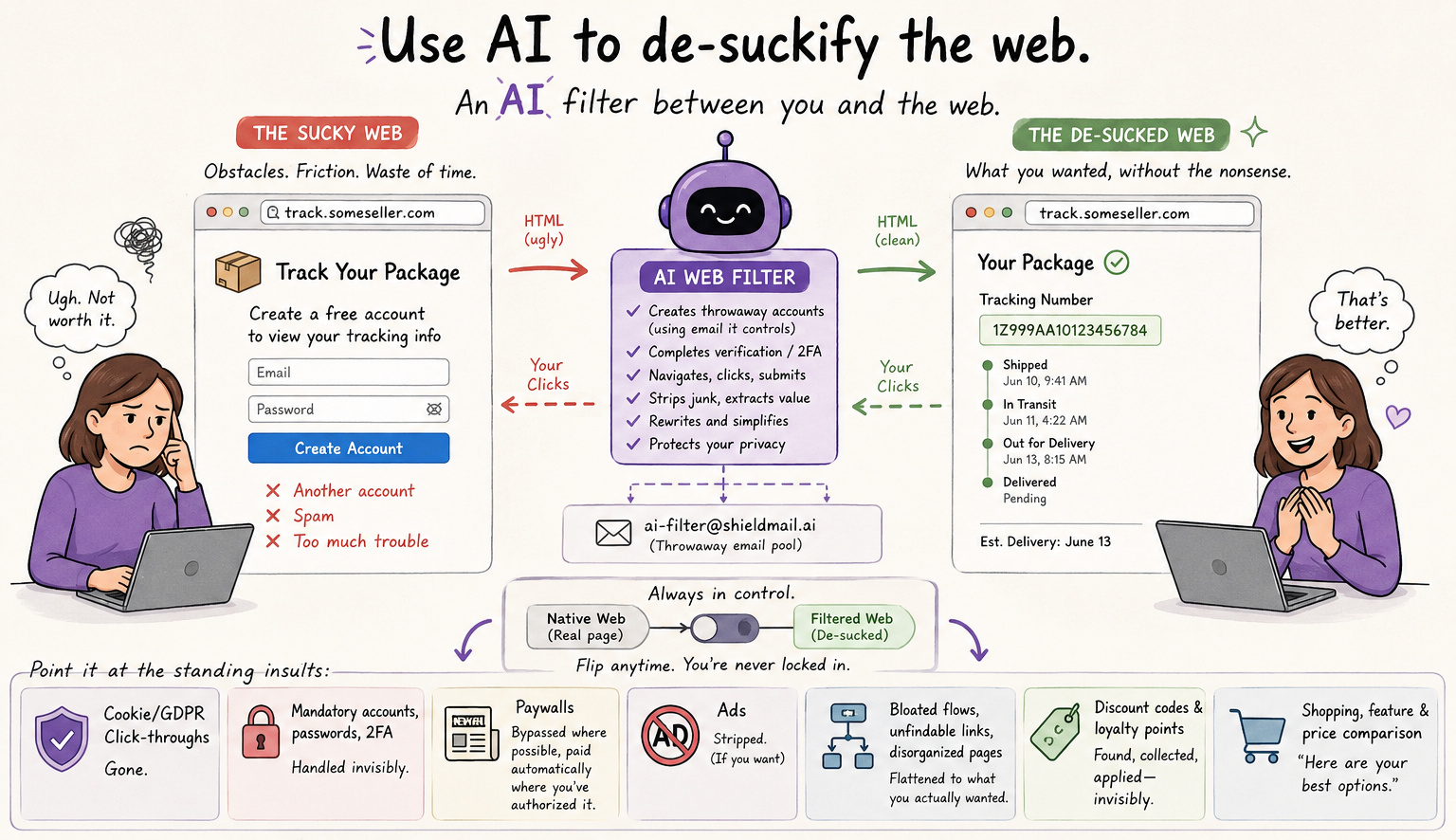
The fix: Use an AI as a filter between the website and her browser. The AI automatically creates a throwaway account using an email address it controls, does the verification, and renders the page as if the wall were never there. She sees the number; she never sees the wall.
Generalize it: an AI as a bidirectional web filter. HTML goes in, the AI rewrites it, your browser renders the de-sucked version. Your clicks go back out through the AI, passed through or rewritten as needed. A toggle flips between the native web and the filtered web, so you can always drop back to the real page.
Point it at the standing insults:
- Cookie/GDPR click-throughs – gone
- Mandatory accounts, passwords, 2FA for trivial actions – handled invisibly
- Paywalls – bypassed where possible, paid automatically where you’ve authorized it
- Ads – stripped (if you want)
- Bloated multi-step flows, unfindable links, disorganized pages – flattened to what you actually wanted
- Discount codes and loyalty points – found, collected, applied – invisibly
- Shopping, feature and price comparison – “here are your best options”
This is a job for the people who build ad blockers. Publishers won’t like it and it violates ToS. I don’t care. If you don’t like it, change your business model. If you’re offering real value people will be willing to pay one way or another.
[Credit to Claude.ai for the first draft and ChatGPT for the illustration. If you hate AI, too bad for you.]
I got one of those e-mails too. It wasn’t a real tracking number, it was a phishing attack, hoping you’d enter your credentials for the real site. It looked really well done too.
The bad guys are upping their game.
Maybe. She said another site sent her to the same place, and it was asking to create a *new* account, not enter credentials for an existing account.
But add that to the list of things the AI could do – not get phished.
I cross-posted this to Reddit and immediately got “no way” from a bunch of people who didn’t realize the AI can run locally – needn’t leak your privates.
Did your wife’s e-mail say who the shipment was from? Mine didn’t.
If not, and if the e-mail was legit, it means your wife ordered something from someone who is using a third-party app to buy shipping labels (not USPS, FedEx, or UPS directly). The seller is giving that third party her e-mail address
Then it sends an e-mail for tracking but doesn’t say who the seller is. And instead of providing a service that’s already been paid for – the tracking info – insists on creating a new account for the recipient.
It’s possible, but it sounds unlikely.
The AI can certainly do some rigorous checks. But using a disposable e-mail wouldn’t work with a legitimate site, since the tracking info is indexed to the recipient’s real e-mail. So the most the AI should do is offer advice as to whether it’s safe to proceed.